Time Dilation
A clock moving relative to an inertial observer accumulates less proper time between two events than a clock at rest with that observer. For constant relative speed,
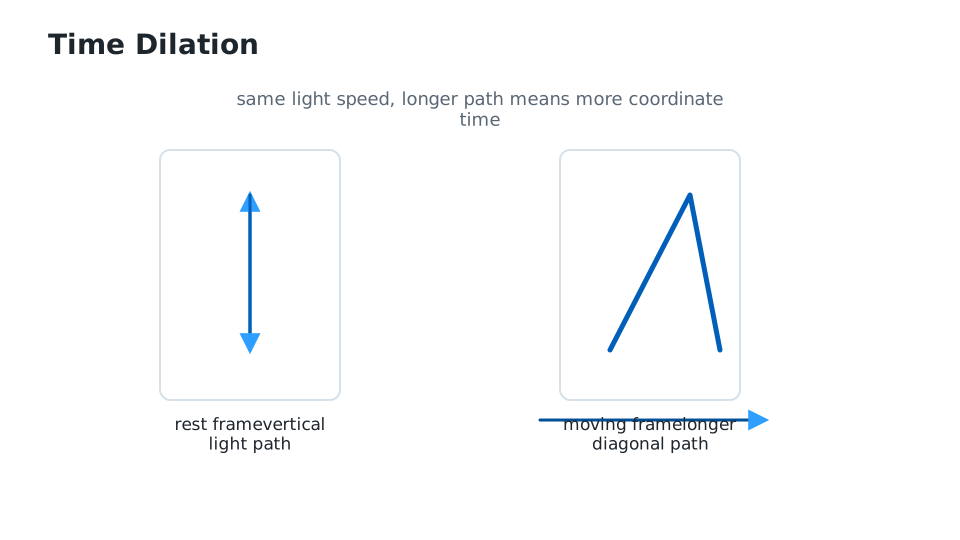
Here Δτ is the proper time measured by the clock that is present at both events; Δt is the longer coordinate-time interval assigned by the observer who sees that clock moving.
At 0.8c, γ≈1.67: if 1 hour passes on the moving clock, the observer assigns about 1 hour 40 minutes between the same events. At 0.99c, one hour of proper time corresponds to about 7.1 hours in that frame.
This is not a mechanical clock defect. Atomic clocks, unstable particles, and every physical process follow the same spacetime geometry. Atmospheric muons provide a striking natural example: moving relativistic muons survive to sea level in far greater numbers than a naive nonrelativistic lifetime calculation would allow.
A common confusion is the twin paradox. During uniform relative motion each inertial observer can regard the other's clock as slow. The traveling twin's turnaround breaks the symmetry because the twins follow different paths through spacetime; their accumulated proper times need not match when reunited.