Suspension: Springs, Dampers, and Tire Contact
A suspension must let the wheels follow an uneven road without making the body follow every disturbance. It must also locate the wheels well enough to transmit steering, driving, and braking forces. These goals compete: an indefinitely soft car would run out of suspension travel; an indefinitely rigid one would transmit road disturbances almost directly.
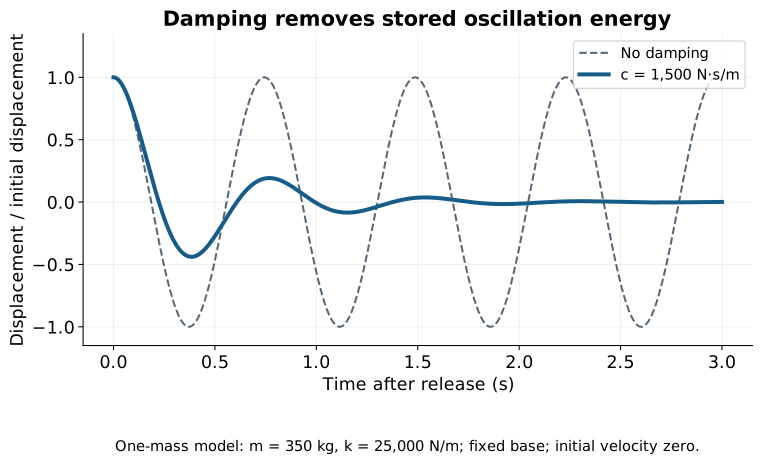
Storing and dissipating are different jobs
A spring carries load and stores energy as it deflects. In a linear approximation, F=-kx and stored energy is kx²/2. A damper resists relative velocity, approximately F=-cẋ, and converts mechanical energy into heat. Its dissipated power is cẋ², always nonnegative in this ideal passive model.
A damper has little ideal viscous force when the suspension is stationary, even if the spring is heavily compressed. A spring can exert a large force at a turning point where instantaneous velocity is zero. That is why the parts cannot substitute for each other. Real dampers have nonlinear valves, different compression/rebound behavior, seals, and other departures from the simple model. ZF component explanation.
For one equivalent body mass on a spring and damper, after an initial disturbance and with the wheel base fixed,
Here displacement is measured from the loaded equilibrium, so gravity is already balanced by static spring deflection. Small damping allows decaying oscillation; very strong damping suppresses overshoot but can slow return. OpenStax's damped-oscillator derivation.
For a hypothetical quarter-car sprung mass of 350 kg and effective wheel rate 25,000 N/m, the undamped body frequency is (√(25000/350)/(2π)=1.35) Hz. With c=1,500 N·s/m, ζ=0.254. This is an illustrative model, not a preferred adjustment. The “wheel rate” includes suspension leverage; it need not equal the spring's measured stiffness.
Why more damping is not automatically better
If road/wheel motion is (y(t)), the relative spring displacement is x-y, and the damper responds to ẋ-ẏ:
Damping reduces resonance, but also forms a force path from rapidly moving wheels to the body. A stiff damper can transmit sharp disturbances that a softer one would isolate. Comfort, body control, tire contact, and available travel are a compromise across frequencies, not a single “firmness” scale.
The road itself supplies a range of frequencies. Repeating bumps 10 m apart encountered at 20 m/s produce a 2 Hz input; the same surface at 10 m/s produces 1 Hz. This converts spatial road features into time-varying forces and explains why a particular road can feel disproportionately troublesome at a particular speed.
The wheel has its own inertia
The wheel, tire, brake, hub, and fractions of suspension members make up unsprung mass. A more useful quarter-car model gives that assembly a second mass and treats the tire as another spring. The body mode and wheel-hop mode are then different motions. Increasing unsprung mass increases the force needed to accelerate the wheel over a short bump; under many conditions this makes contact-load control harder. It is not a claim that removing mass alone guarantees better handling.
Tire contact is a force, not a yes/no flag. A wheel may remain touching the road while its normal force fluctuates enough to change braking and cornering capacity. Suspension therefore connects directly to ABS and braking, not merely passenger comfort.
Wheel location matters as much as spring rate
Control arms, links, struts, or a live axle constrain the wheel's path. Their pivots determine camber and toe changes through travel. Bushings deform under load, producing additional compliance steer. Steering geometry defines these angles and explains why tying steering links to a moving suspension requires care.
An anti-roll bar resists unequal left-right suspension deflection. In an ideal symmetric two-wheel bump it twists little; when one wheel rises relative to the other, it adds coupling. It can reduce body roll, but also affects how lateral load transfer is distributed between axles. Tires are load-sensitive, so changing that distribution can alter front/rear grip balance. A flatter-looking body is not proof of increased total grip.
Takeaway: Springs store, dampers dissipate, links locate, and tires deform. Suspension quality is how those actions work together across different road inputs and maneuvers.