Early Earth: What the Rocks Actually Tell Us
A wet planet is not yet a living planet. Before asking how life began, ask a narrower question: what environments were actually available, and how do we know? This is where origin-of-life research meets geology rather than a cinematic reconstruction of a steaming ocean.
Earth's age establishes the planetary clock. The task here is different: reconstructing conditions during the Hadean and early Archean from a severely incomplete record. The Hadean covers Earth's earliest history, conventionally ending around 4.0 billion years ago; the Archean follows until 2.5 billion years ago. A boundary in a time chart is not evidence that every part of Earth changed state simultaneously.
One crystal, two different questions
A zircon can survive after its original rock has eroded or melted. A roughly 4.4-billion-year-old Jack Hills zircon therefore gives us an unusually old sample, but it was later deposited in younger sediment. The mineral's crystallization age and the age of the rock holding it are different.
Two kinds of measurement do different work:
- Uranium–lead ratios constrain crystallization age. Agreement between radioactive clocks and examination of later alteration help test whether the age is trustworthy.
- Oxygen-isotope ratios constrain the history of the material from which the crystal formed. Chemical reactions partition light and heavy oxygen differently; some compositions are consistent with source rocks that interacted with liquid water at relatively low temperatures before remelting.
The original zircon study thus supports an early hydrosphere through a chain of inference. It does not contain preserved seawater, a thermometer reading for the entire ocean, or a fossil. A later atom-probe study mapped lead redistribution on nanometre scales and tested whether it could bias the ancient age. Checking a proxy's physical integrity is as important as interpreting its attractive number.
A 2024 study interpreted low oxygen-isotope values in approximately 4.0-billion-year-old zircons as evidence for interaction with meteoric water: rain or snow derived from evaporation and condensation. Such an interpretation implies exposed crust and a water cycle. It remains an inference from mineral chemistry and modelling, not a recovered map of Hadean continents.
Why the location matters chemically
“Ocean,” “pond,” and “vent” are not interchangeable containers. They impose different constraints on the same molecules.
| Setting | Useful physical feature | Constraint that comes with it |
|---|---|---|
| Exposed shallow pools | Evaporation, drying, sunlight and repeated refilling | Useful products must survive radiation, heating and changing salts |
| Submarine alkaline vents | Continuing rock–water reactions, chemical gradients and mineral pores | Dilution, seawater chemistry and escape from mineral confinement must be addressed |
| Cold brines or partly frozen water | Ice excludes many dissolved solutes into residual liquid, concentrating them | Reactions can become slow; freeze–thaw cycles must be compatible with the chemistry |
| Mineral surfaces | Adsorption can gather molecules and change reaction rates | Strong adsorption may trap products that need to leave or be copied |
These are proposed advantages and trade-offs, not a ranking of demonstrated birthplaces. The useful question is whether a setting supplies a compatible sequence of conditions. A molecule synthesized in one environment may need transport to another, but each added transport or purification step creates another claim to test.
There is stronger direct sedimentary context later. The approximately 3.48-billion-year-old Dresser Formation preserves deposits interpreted as terrestrial hot springs, alongside evidence of microbial activity. Djokic and colleagues used sedimentary textures and comparisons with modern spring deposits to reconstruct that setting. This makes hot springs credible early habitats; it does not show that their inhabitants originated there.
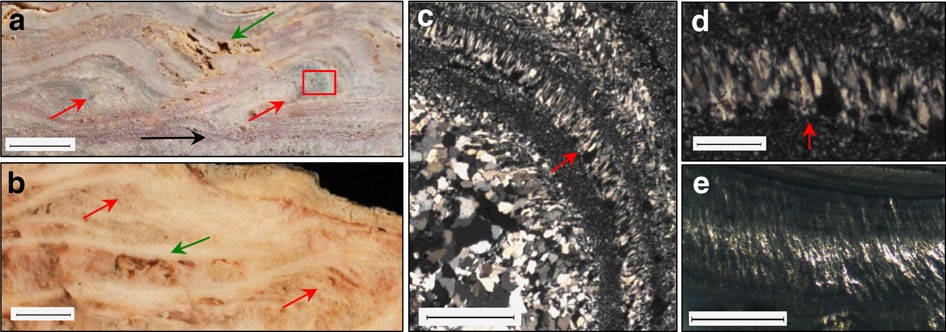
Figure: Djokic et al. (2017), Figure 2, unchanged, CC BY 4.0, external provenance. Scale bars: a and b, 1 cm; c and e, 1 mm; d, 250 μm. Similar textures motivate a habitat interpretation; resemblance alone is not the whole biological argument.
A disciplined reading of the missing record
The record is biased toward materials that survived burial, heating, deformation and recycling. A missing fossil from a time with almost no preserved sediment is weak evidence that life was absent. Conversely, an old mineral does not make every inclusion inside it equally old: later fluids or cracks can introduce material.
Keep three claims separate:
- Available conditions: water, mineral surfaces, chemical gradients or exposed land existed.
- Chemical possibility: a laboratory reaction can work under a specified subset of those conditions.
- Historical occurrence: the reaction actually participated in the emergence of life on Earth.
Evidence for one does not automatically establish the next. The origin-of-life problem begins when prebiotic chemistry must turn environmental opportunity into sustained, organized chemical production.