Electric Fields: Charge, Superposition, and Cancellation
Why can a neutral object respond to electricity, and why does zero total charge not imply zero field? The answer requires separating sources, fields, and the charge experiencing a force.
This sequence extends mechanics in a useful order: fields and their symmetry → potential and energy → current and circuits → magnetic force and induction. Thermal physics then follows energy into microscopic motion. These are tractable models, not a claim that all electrical devices reduce to ideal resistors.
Charge produces a field
Electric charge is conserved. In ordinary matter, electrons carry negative charge and protons positive charge; a neutral body has balanced totals, not an absence of charged constituents. Charge can redistribute without changing the body's total. This polarization explains how a charged object can attract neutral matter.
For a stationary point source charge Q in vacuum,
Here r is distance from the source and r̂ points from source to observation point. Positive Q gives an outward field; negative Q an inward one. The force on a test charge is vec(F)=qvec(E). A negative charge therefore accelerates opposite to the field. “Test” means small enough that its presence does not appreciably rearrange the sources.
Coulomb's law is an experimentally grounded law, not a consequence of the definition of field. The inverse-square dependence also explains why flux through concentric spheres stays constant: sphere area grows as r². Gauss's law develops that connection.
Add vectors, not magnitudes
In electrostatics the field of several source charges is the sum of their individual fields:
For continuous distributions, replace the sum by ∫ kr̂ dq/r². Break vectors into components before integrating unless symmetry already determines the direction. The charges may rearrange in response to each other; superposition applies to their actual arrangement, not necessarily the arrangement before they interacted.
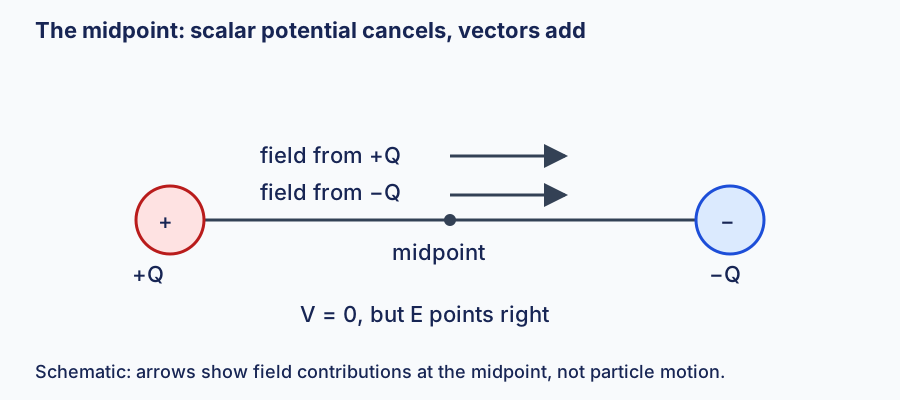
Place +2.0 nC at x=-0.10 m and -2.0 nC at x=+0.10 m. At the origin, each field has magnitude
Both point right. The total is approximately 3.60×10³ N/C rightward, despite zero total charge. A -1.0 nC test charge there experiences 3.60 μ N leftward. If both source charges were positive, the fields would cancel at the midpoint instead. Moving off that point generally restores a field.
Cancellation has a geometry
For two equal positive charges at x=± a, consider a point on the perpendicular bisector (0,y). The horizontal components cancel and vertical components add. Each distance is √(a² + y²), and the vertical projection contributes a factor y/√(a² + y²):
At y=0 the field vanishes. Far away, y≫ a, it approaches 2kQ/y²: the unresolved pair behaves approximately like one charge 2Q. Equal opposite charges instead have a faster-decaying far field because their leading contributions cancel. The details of arrangement survive after net charge has told us too little.
Field lines are a visualization: their tangent gives field direction and their density suggests strength. They are neither physical threads nor, in general, particle trajectories. A moving particle retains velocity and responds to acceleration; it need not follow a field line.