Electric Flux and Gauss’s Law: When Symmetry Does the Work
Gauss's law is always true for electric fields, but it is not always a shortcut for finding them. Its power comes from combining a global accounting rule with enough symmetry to determine a local field.
Flux counts the normal component
For uniform field through a flat area, electric flux is ΦE=EAcosθ, where θ is measured from the surface normal, not the surface itself. For a curved closed surface,
The area vectors point outward. Inward field contributions are negative. Flux is not current: no material needs to flow through the surface. A uniform external field passing through an empty box gives equal inward and outward contributions and hence zero net flux, although the field is nonzero on its faces.
For a point charge at the center of a sphere, Coulomb's law gives
Moving the surface outward reduces field strength by precisely the factor by which area grows. The general law survives distorted surfaces, off-center sources, and superposition. But writing EA for the integral requires proving that the relevant normal field component is constant over the chosen area.
A solid sphere is not a conducting shell
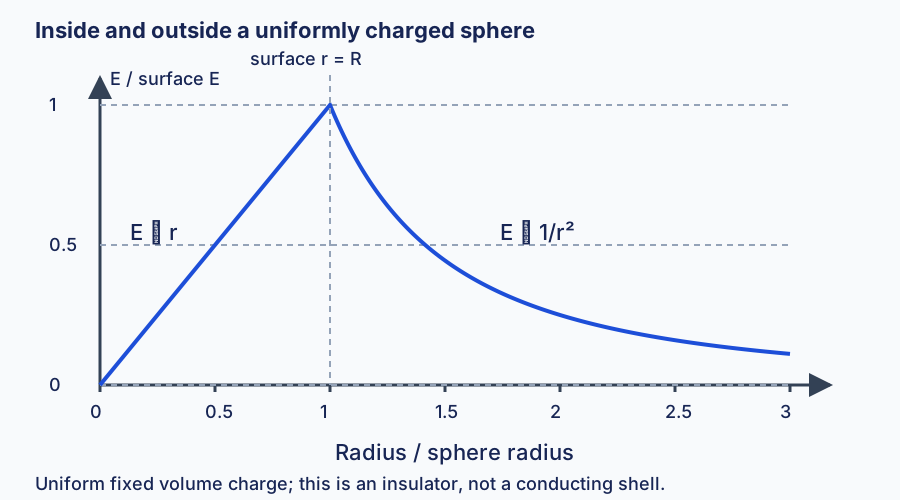
Take a nonconducting sphere of radius R, carrying a fixed, uniform volume charge density ρ. Spherical symmetry makes the field radial and constant in magnitude on a concentric Gaussian sphere. Inside,
Outside, all charge Q is enclosed and E=Q/(4πε₀r²). Thus the field starts at zero, rises linearly, reaches its maximum at the surface, and falls inversely with distance squared. Applying the outside formula inside would predict an unphysical divergence at the center because it incorrectly counts charge outside the Gaussian surface as enclosed.
For Q=3.0 nC, R=0.20 m, the surface field is about 674 N/C. Halfway to the surface it is 337 N/C; at twice the sphere's radius it is 169 N/C. The two factors of two describe different charge-enclosure regimes.
Conductors rearrange the sources
A conductor contains mobile charge. In electrostatic equilibrium its material has zero electric field: otherwise free charges would keep moving. Its connected surface is an equipotential. Excess charge sits on surfaces, and the external field at a smooth surface is perpendicular to it; a tangential component would drive surface motion.
A Gaussian surface lying wholly within the conductor's material has zero flux and therefore encloses zero net charge. If an internal cavity contains a charge, induced charge on the cavity wall balances it for this accounting. “The field is zero inside a conductor” refers to the conducting material; an occupied cavity can contain a field. A current-carrying resistive wire is also not in electrostatic equilibrium and generally has a nonzero internal field.
Two other symmetries worth recognizing
For an ideal infinite line of charge, a coaxial cylinder gives E(2π rL)=λ L/ε₀, so E=λ/(2πε₀r). A line's field falls as 1/r, not 1/r², because the source is extended.
For an infinite sheet with uniform surface charge density σ, a pillbox has flux through its two flat ends: 2EA=σ A/ε₀. Therefore each side has E=σ/(2ε₀). Two large oppositely charged plates approximately cancel outside and add inside, giving E≈σ/ε₀ away from edges. That is the field model behind a parallel-plate capacitor.
Finite lines and plates only approximate these results where their edges are sufficiently remote. Symmetry is a physical assumption, not a permission to ignore inconvenient geometry.