Earliest Life: Fossils, Inference and the Road to Oxygen
The oldest surviving evidence of life supplies a minimum antiquity, not a birthday. If a convincing fossil is 3.48 billion years old, life was present by then; it may have begun much earlier. Nor does finding life in one habitat prove that life originated there.
This is the historical counterpart to the experiments in RNA replication and protocells. Laboratories test possible mechanisms. Rocks preserve fragmentary outcomes, usually after extensive alteration.
What makes a trace biological?
Three broad types of evidence can converge:
- Morphology and organization: cell-like structures, repeated growth patterns or laminated structures consistent with microbial mats.
- Chemistry: organic material distributed in a way consistent with the structures and their depositional history.
- Isotopes: patterns compatible with metabolism, such as preferential incorporation of lighter carbon into organic matter.
None is automatically decisive. Minerals can make spheres and filaments; precipitation can make laminations; nonbiological reactions can fractionate isotopes. Carbon can enter an old rock through a younger crack. The test is not “does it resemble life?” but “does a biological interpretation explain the combined observations better than realistic alternatives?”
Syngenicity is the key temporal question: did the candidate trace form with the sediment, rather than arrive later? Dating the host rock is necessary but not sufficient. Cross-cutting relationships, mineral context, alteration history and measurements at multiple scales help answer it.
Why the roughly 3.5-billion-year record is important
Stromatolites are layered sedimentary structures commonly formed through microbial activity, including trapping sediment and influencing mineral precipitation. The stronger ancient examples combine structure with context rather than relying on a single attractive dome.
In the approximately 3.48-billion-year-old Dresser Formation, Baumgartner and colleagues studied material from below the weathered surface. Organic matter associated with early-formed pyrite and stromatolitic textures strengthened a biological interpretation. The argument combines mineral sequence, microscopic organization and chemistry. It does not identify the organisms' complete genomes or show which origin scenario produced them.
Older proposed traces are scientifically important but vary in strength. Nutman and colleagues interpreted structures in approximately 3.7-billion-year-old Greenland rocks as stromatolites. Allwood and colleagues re-examined their three-dimensional form and geological context and argued that deformation explained them instead. A cone in one exposed section can be part of a ridge in three dimensions.
This dispute concerns those particular structures. It does not establish that life was absent at 3.7 billion years, or settle every independent chemical claim from rocks of that age. “Oldest life” headlines often erase that distinction.
A 2025 Isua study compared graphite in metasedimentary minerals with graphite in later veins. Different isotope distributions and preservation contexts supported the authors' interpretation of sediment-associated material as biogenic. The point is methodological: identifying which carbon population is being measured matters, even when their average isotope values are similar.
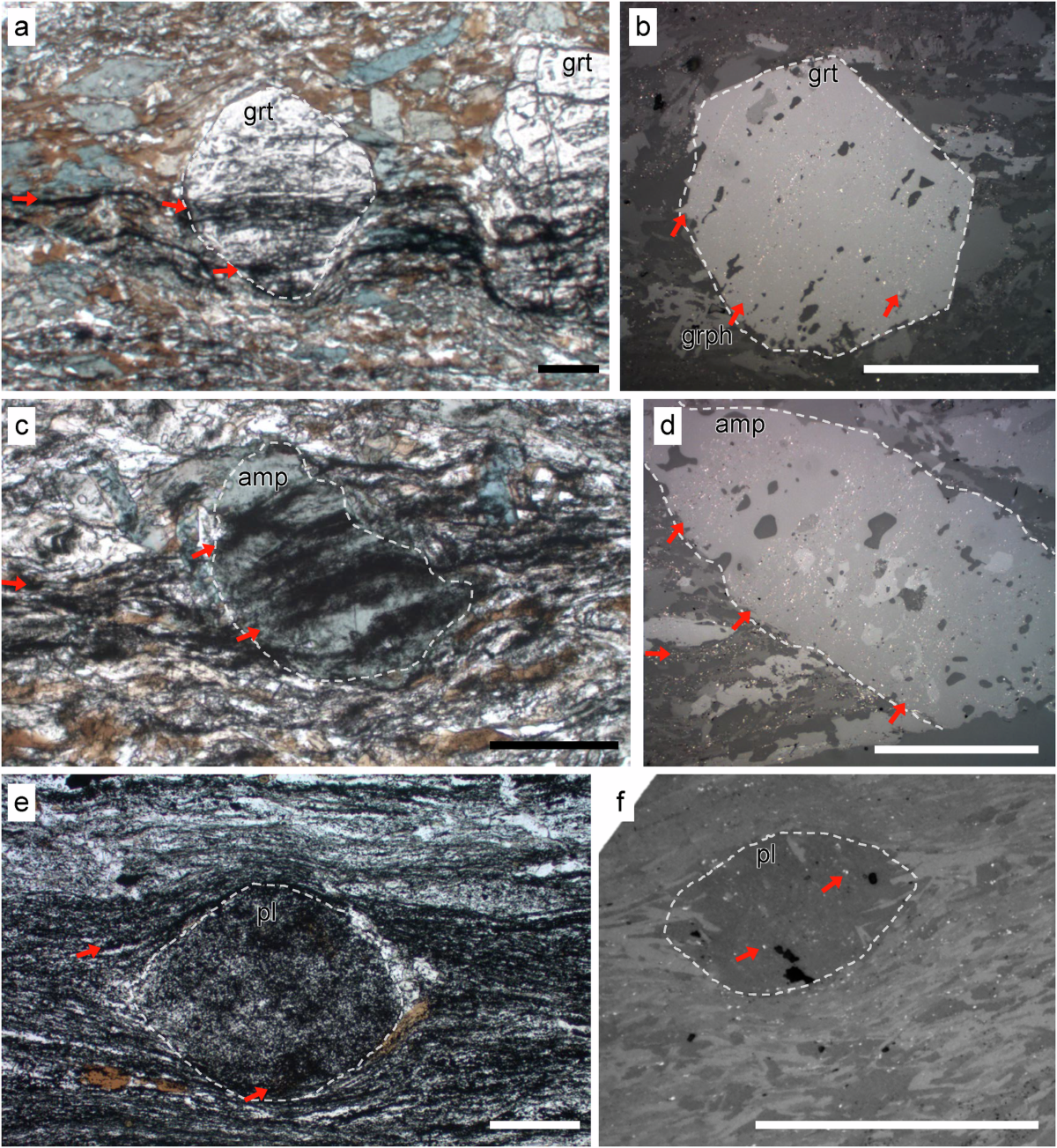
Figure: Harding et al. (2025), Figure 2, unchanged, CC BY 4.0, external provenance. Every scale bar is 200 μm. Mineral abbreviations: grt, garnet; amp, amphibole; pl, plagioclase; grph, graphite.
A chronology of claims, not a sequence of inventions
| Approximate age | Evidence or inference | What it does not date |
|---|---|---|
| 4.4 billion years | Zircons support early crust and water–rock interaction | The origin of life |
| 4.2 billion years | A 2024 molecular-clock study's estimate for LUCA | A directly dated fossil or the first organism |
| 3.7 billion years | Older proposed biosignatures, including disputed Greenland structures | An agreed universal starting date |
| 3.48 billion years | Strong convergent evidence in Dresser Formation microbial structures | The first appearance of every represented metabolism |
| Around 2.4 billion years | Great Oxidation Event | The first life or necessarily the first oxygenic photosynthesis |
| Around 1.75 billion years | Preserved thylakoid membranes in cyanobacterial fossils | The first oxygen production; this evidence is younger than the GOE |
The first row is explained in early-Earth habitability. The purpose of the table is to prevent differently justified dates from being treated as equally direct observations.
LUCA was not the first life
The last universal common ancestor, or LUCA, is the ancestral population from which all surviving cellular life descends. It could already have inherited a long evolutionary history. Earlier lineages may have vanished without leaving living descendants, and horizontal gene transfer means different genes do not always tell identical histories.
A 2024 reconstruction inferred a comparatively complex LUCA and estimated an age near 4.2 billion years using molecular clocks and comparative genomics. That is a model-dependent estimate, not a 4.2-billion-year-old cell recovered from a rock. Deep calibrations, assumptions about evolutionary rates, gene loss and gene transfer matter. Even a perfectly known LUCA date would date shared surviving ancestry rather than abiogenesis itself.
Life came before an oxygen-rich atmosphere
Do not conflate photosynthesis with oxygen production. Light can power metabolism using electron donors other than water. Oxygenic photosynthesis extracts electrons from water and releases molecular oxygen; the timing of its origin remains uncertain.
By the Great Oxidation Event, oxygen-producing biology and the planet's chemical sinks had entered a new balance. Sulfur-isotope patterns provide evidence independent of simply identifying a photosynthetic fossil: certain mass-independent signatures record atmospheric photochemistry that was possible under very low oxygen. Their large-scale change helps constrain atmospheric oxygenation, as established by Farquhar and colleagues.
A useful caution comes from fossil thylakoids reported in 2024. These internal photosynthetic membranes provide direct cellular evidence around 1.75 billion years ago. They are younger than the GOE. An unusually specific fossil can therefore give a younger minimum age than broader geochemical evidence for the process.
The durable conclusion is a hierarchy: early environments became available; evolving life was established by the early Archean record; oxygenic photosynthesis arose at an uncertain later point; and atmospheric oxygen accumulated on a planetary scale much later than the first life. The chemistry linking the first two remains an active research problem, not a settled itinerary.